Cheat Sheet to Coffee vs Espresso Differences

What's Actually the Difference Between Coffee and Espresso?

The difference between coffee and espresso comes down to one thing: how they're brewed. Espresso isn't a different bean or a separate drink category. It's coffee, made under pressure.
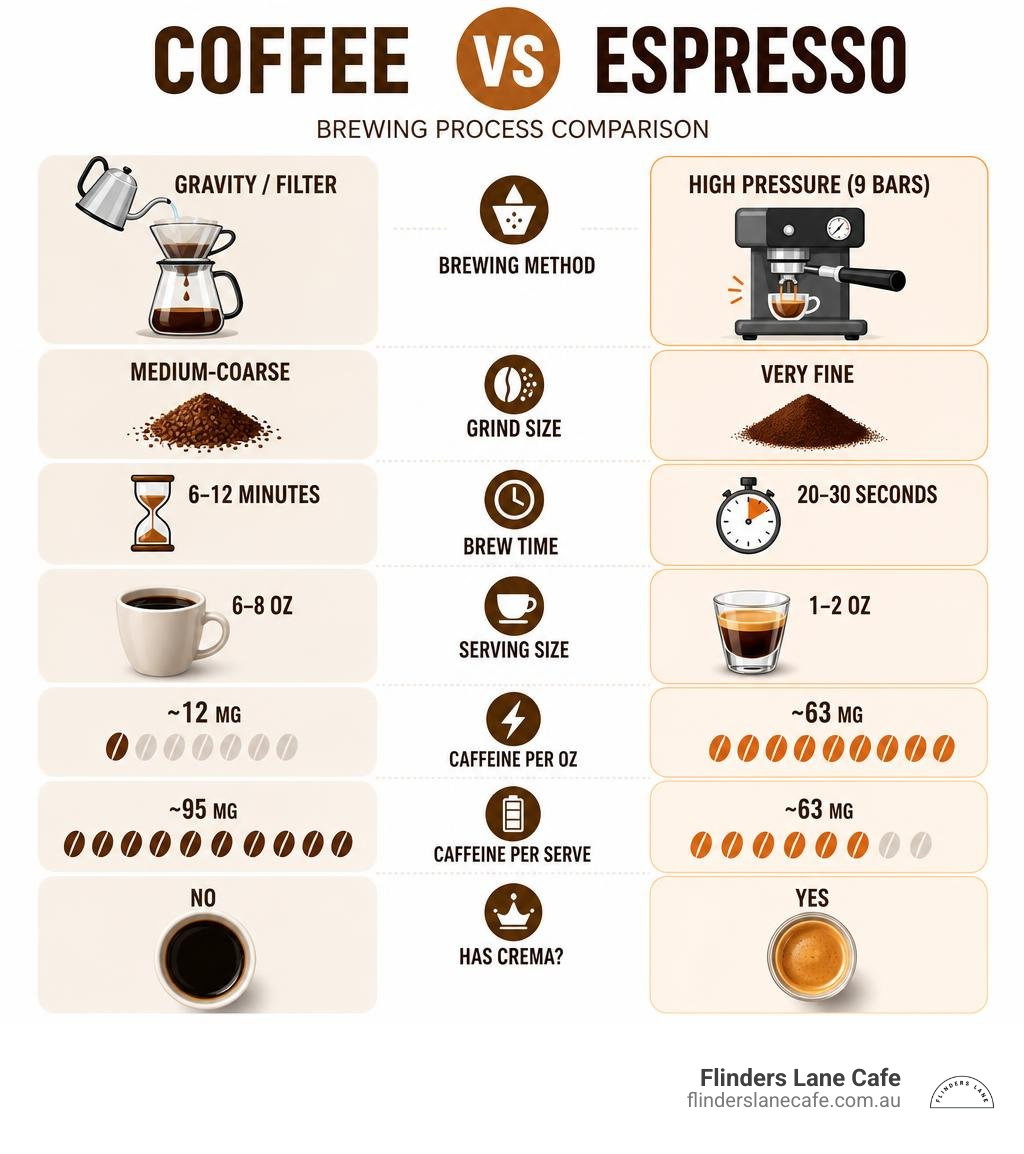
Here's a quick snapshot before we dive in:
| Espresso | Drip Coffee | |
|---|---|---|
| Brewing method | High pressure (9 bars) | Gravity / filter |
| Grind size | Very fine | Medium-coarse |
| Brew time | 20-30 seconds | 6-12 minutes |
| Serving size | 1-2 oz | 6-8 oz |
| Caffeine per oz | \~63 mg | \~12 mg |
| Caffeine per serve | \~63 mg | \~95 mg |
| Has crema? | Yes | No |
So while a shot of espresso is more concentrated per ounce, a standard cup of drip coffee actually delivers more total caffeine. Surprising, right?
Both start with the same roasted coffee bean. What changes everything is the process: the grind, the pressure, the time, and the ratio of coffee to water.
I'm Janice Kutz, owner of Flinders Lane Cafe in Maroochydore, and with over 20 years in hospitality, I've answered the difference between coffee and espresso question more times than I can count. Read on and I'll break it all down in plain language so you can order, brew, and enjoy with confidence.
To master the basic vocabulary, it helps to understand the difference between coffee and espresso beans as well as the subtle distinctions in how roasters label them, which you can explore in our guide on the difference between espresso beans and coffee beans.
The Real Difference Between Coffee and Espresso Explained
To understand the core difference between coffee and espresso, it helps to use a simple analogy. Think of the relationship between a rectangle and a square. Every square is a rectangle, but not every rectangle is a square. In the exact same way, all espresso is coffee, but not all coffee is espresso.
When you order a standard filter coffee, the brewing process relies on the gentle force of gravity. Hot water slowly drips through a bed of relatively coarse coffee grounds, passing through a paper or metal filter before landing in your pot. This process takes several minutes, resulting in a lighter, cleaner liquid where the dissolved coffee solids make up only about 1.5% to 2% of the final beverage. It is a delicate, highly approachable drink designed for slow sipping.
Espresso, on the other hand, is a highly concentrated, incredibly intense style of coffee. It is brewed by forcing a small amount of nearly boiling water through a tightly compacted "puck" of very finely ground coffee under immense pressure. Because of this rapid, high-pressure extraction, the final beverage is thick, viscous, and incredibly complex. In fact, a quality shot of espresso contains about 10% dissolved coffee solids. This means it is roughly five times more concentrated than a standard cup of drip coffee.
Understanding this distinction is the first step in mastering coffee culture. If you want to explore the basics further, check out our Beginner's Guide To The Difference Between Coffee And Espresso for a simple breakdown of how these drinks compare. For a deeper look into how they stack up side-by-side in daily life, our comprehensive guide on Espresso Vs Coffee covers everything you need to know.
Brewing Methods and the Science of Pressure
The magic of espresso lies in the physics of pressure. To create a true espresso, a specialised machine must generate at least 9 bars of pressure. To put that in perspective, 9 bars is roughly nine times the atmospheric pressure at sea level, or about 130 pounds per square inch (PSI). This is roughly three times the pressure inside a typical car tyre.
When hot water, heated to a precise temperature between 90 and 96 degrees Celsius, is forced through the finely ground coffee puck at this extreme pressure, it does something gravity cannot. It physically forces the natural oils and soluble compounds out of the coffee plant's cell walls, creating a beautiful colloidal emulsion. This emulsion contains tiny droplets of coffee oils suspended in the liquid, giving espresso its signature velvety mouthfeel and heavy body.
In contrast, standard drip coffee makers, pour-overs, and French presses do not use mechanical pressure. They rely on immersion or gravity. The water temperature is similar, but because there is no pressure forcing the water through the grounds, the extraction takes much longer. Instead of the lightning-fast 20 to 30 seconds required for an espresso shot, filter coffee requires anywhere from 2 to 6 minutes of contact time to fully extract the flavours. Because the water passes through a paper filter, most of the natural oils are trapped, leaving behind a clear, oil-free liquid.
This scientific difference is why you cannot simply make drip coffee "stronger" to turn it into espresso. No matter how much coffee grounds you use, a gravity-based system will never produce the emulsified oils that define a true espresso.
Grind Size and Extraction: A Key Difference Between Coffee and Espresso
To achieve the perfect extraction, you must match your grind size to your brewing method. The grind size controls the flow rate of the water and determines how much surface area of the coffee is exposed.
Because espresso brews so quickly, it requires a very fine grind, similar in texture to table salt or powdered sugar. This fine grind dramatically increases the total surface area of the coffee, allowing the high-pressure water to extract the flavours in just 25 seconds. The fine particles also pack tightly together in the portafilter, creating the exact amount of resistance needed to slow down the pressurised water. If the grind is too coarse, the water will rush through too quickly, resulting in a watery, sour, under-extracted shot. If it is too fine, the machine will struggle to push the water through, resulting in a bitter, over-extracted drip.
Filter coffee, however, requires a medium-to-coarse grind, resembling sea salt or wet sand. Because the water remains in contact with the coffee grounds for several minutes, a fine grind would cause massive over-extraction. The water would extract too many bitter compounds, and the paper filter would quickly clog, leaving you with a bitter, muddy cup. By using a coarser grind, we ensure a slower, gentler extraction that highlights the delicate, bright, and fruity notes of the bean.
If you are setting up your grinder at home, matching these settings is vital. You can read our detailed guide, the Espresso Vs Espresso Coffee Guide, to learn how to dial in your grind.
Caffeine Content: The Surprising Difference Between Coffee and Espresso
One of the most common myths in the coffee world is that espresso contains far more caffeine than regular coffee. While this is technically true on an ounce-by-ounce basis, it is completely false when you look at a typical serving size.
To understand this, we have to look at the concentration versus the total volume. A single shot of espresso is typically only 1 ounce (30 ml) and contains about 63 mg of caffeine. A standard cup of drip coffee is about 8 ounces (240 ml) and contains approximately 95 mg of caffeine.
If you drink a single shot of espresso, you are actually consuming less total caffeine than if you drank a standard mug of black filter coffee. However, because the espresso shot is so small, you consume that caffeine much faster. This rapid consumption leads to a quicker, more intense energy boost, which is why people often perceive espresso as being significantly stronger.
If you are watching your daily caffeine intake, keeping these serving sizes in mind is essential. For a complete breakdown of how caffeine levels vary across different drinks, take a look at our Espresso Vs Coffee Caffeine Guide.
What is Crema and Why is it Unique to Espresso?
If you have ever looked closely at a freshly poured shot of espresso, you have undoubtedly noticed the beautiful, thick, golden-brown layer of foam sitting on top. This is called the crema, and it is the ultimate hallmark of a well-brewed espresso.
Crema is a direct byproduct of high-pressure extraction. When coffee beans are roasted, carbon dioxide gas becomes trapped inside the cells of the bean. When the espresso machine forces water through the tightly packed grounds at 9 bars of pressure, it dissolves this carbon dioxide into the liquid.
As the brewed espresso exits the portafilter and flows into your cup, the liquid suddenly returns to normal atmospheric pressure. This sudden drop in pressure causes the dissolved carbon dioxide to rapidly expand, creating thousands of microscopic bubbles. These tiny bubbles trap the emulsified coffee oils, rising to the top to form a thick, velvety foam.
Crema is unique to espresso because gravity-based brewing methods simply do not have the pressure required to dissolve carbon dioxide into the liquid. It serves as a visual indicator of freshness and quality. If your espresso has a rich, persistent crema, it means the beans are fresh and the shot was extracted perfectly. If the crema is thin, pale, or non-existent, the beans may be stale or the grind may have been too coarse.
Espresso-Based Drinks vs Regular Brews
Once you have mastered the art of pulling a perfect shot of espresso, you have the foundation for an entire menu of delicious drinks. Espresso's intense concentration makes it the perfect partner for milk, as its bold flavour can easily cut through the sweetness of dairy or plant-based alternatives.
We have a world-famous coffee culture built entirely around espresso-based drinks. The most iconic of these is the flat white, which features a double shot of espresso topped with hot, velvety micro-foamed milk, served in a compact 150-175ml cup. Unlike a latte, which has a thicker layer of foam, or a cappuccino, which is divided into equal parts espresso, steamed milk, and thick froth, the flat white focuses on a seamless blend of liquid and milk.
If you prefer your coffee black but want a larger volume than a single shot, the Americano is the perfect choice. Created by brewing a double shot of espresso directly over hot water, it mimics the volume of a drip coffee while retaining the distinct, rich characteristics of espresso extraction.
Beans and Roasts: Myth vs Reality
Another common misconception is that you must buy specific "espresso beans" to make espresso. The reality is that there is absolutely no botanical difference between a coffee bean and an espresso bean. Any coffee bean, from any origin, can be used to make either regular coffee or espresso.
The label "espresso roast" on a bag of beans simply indicates that the roaster has roasted the beans in a way that complements the espresso extraction process. Typically, this means roasting the beans slightly longer and darker. Darker roasts are less acidic, have a heavier body, and allow the natural oils to migrate to the surface of the bean more easily. This helps to create a thicker, more stable crema and a bold, classic flavour profile that tastes incredible when paired with milk.
However, the modern specialty coffee movement has completely blurred these lines. Today, many cafes use lighter, single-origin roasts for espresso to highlight delicate floral, fruity, and sweet flavours. If you want to dive deeper into how roasting styles affect your brew, check out our guide on the Difference Between Coffee And Espresso Beans.
Experience the Best Brews at Maroochydore
At Flinders Lane Cafe, located at Unit 2/31 Flinders Ln, Maroochydore QLD 4558, we live and breathe coffee. Whether you are craving the bright, clean notes of a filter brew or the rich, velvety punch of a perfectly poured flat white, our team is dedicated to serving the finest specialty coffee on the Sunshine Coast.
Owned by Janice Kutz, we believe that exciting things happen when people come together over good coffee and food. Our cafe is designed to be a warm, inclusive community hub where you can slow down, connect with friends, or simply enjoy a quiet moment to yourself. We are proud to be completely dog-friendly, so bring your four-legged companion along to enjoy our outdoor seating area, we even offer fluffy puppacinos with treats to make them feel welcome.
Our passion for quality extends far beyond the coffee cup. We focus on sustainability, easy living, and enjoyable shared experiences. Our kitchen serves up a delicious range of breakfast and brunch favourites, including our famous Chilli Scramble, classic Bacon Benny, Brekky Muffin, B&E Roll, and classic Ham & Cheese Toastie. If you are looking for something lighter, try our Avocado Toast, Veggie Sando, or Reuben Sando, with gluten-free options (gfo) available upon request. We also offer refreshing Mango and Berry smoothies alongside our extensive tea and matcha selection.
We are open Mon-Fri 6:00am-1:30pm and Sat-Sun 7:00am-1:00pm. Whether you are a local from Cotton Tree, Alexandra Headland, Buderim, or North Buderim, we would love to welcome you into our space.
To explore our full range of food and drinks, you can view the Flinders Lane Cafe Menu. If you would like to get in touch with us about events or general enquiries, head over to the Contact Flinders Lane Cafe page. For more brewing tips, local stories, and coffee guides, be sure to visit the Flinders Lane Cafe Blog.
Drop by Flinders Lane Cafe in Maroochydore and treat yourself to your morning fix today! Show our staff your 5-star review and receive a FREE small coffee on us!