Cappuccino Espresso to Milk Ratio Secrets for the Home Barista

The Cappuccino Espresso to Milk Ratio That Changes Everything

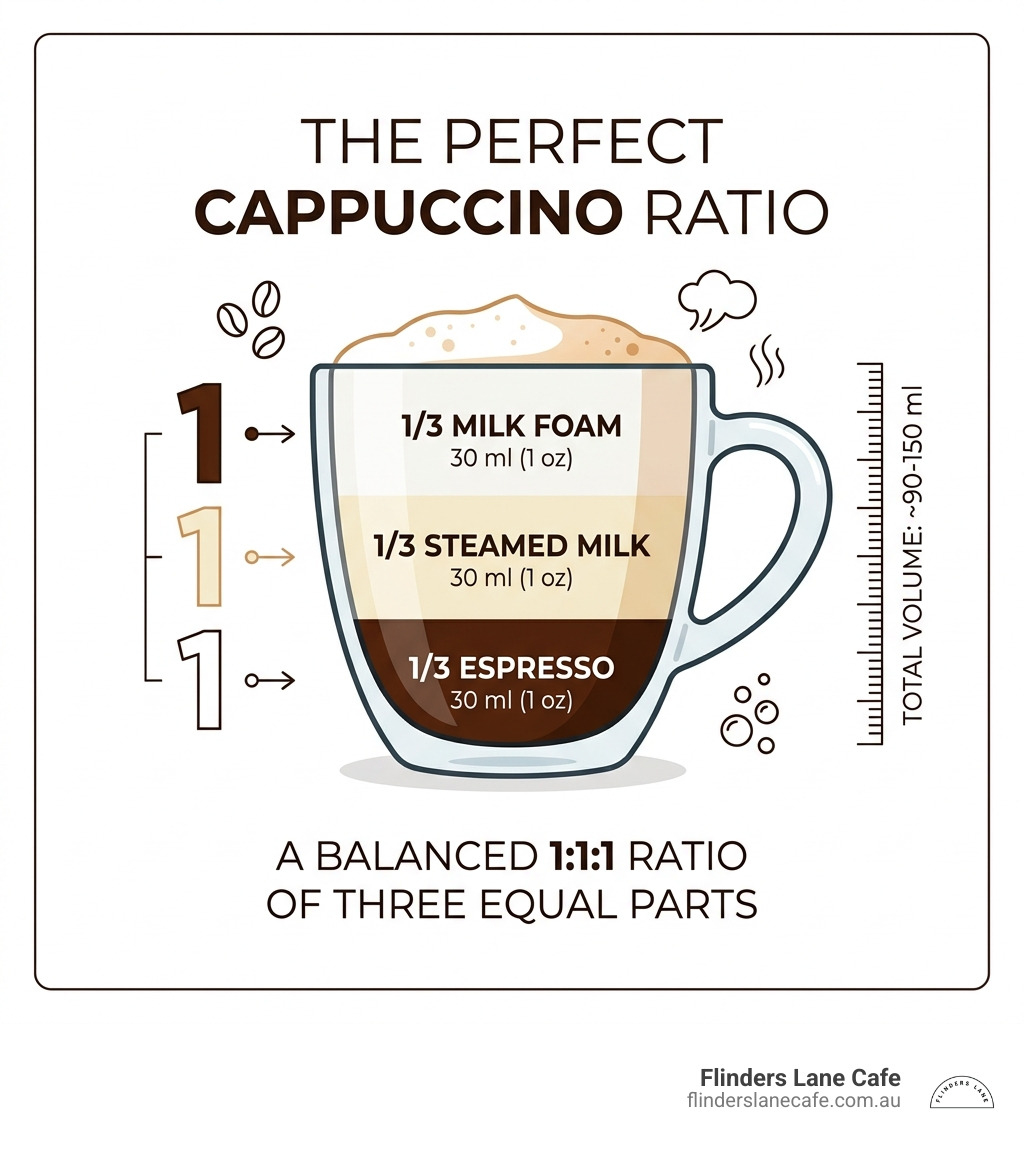
The cappuccino espresso to milk ratio is simpler than most people think: it's equal thirds of espresso, steamed milk, and milk foam.
Here's the quick answer:
| Component | Volume | Ratio |
|---|---|---|
| Espresso | 30 ml (1 oz) | 1/3 |
| Steamed milk | 30 ml (1 oz) | 1/3 |
| Milk foam | 30 ml (1 oz) | 1/3 |
| Total | \~90-150 ml | 1:1:1 |
That 1:1:1 rule is the foundation of every great cappuccino. Get it right, and you unlock that perfect balance of bold espresso, creamy sweetness, and velvety foam.
Get it wrong, and you've just made a very expensive warm milk.
There's something special about that first sip of a properly made cappuccino on a Maroochydore morning. The hiss of the steam wand, the rich aroma curling up from the cup, the way the foam sits just so. It's not just coffee. It's a moment.
Whether you're trying to recreate that experience at home or simply want to understand what's inside your favourite cup, knowing the ratio is your starting point.
I'm Janice Kutz, owner of Flinders Lane Cafe in Maroochydore, and with over 20 years in hospitality, I've seen how understanding the cappuccino espresso to milk ratio separates a forgettable cup from one that keeps people coming back every single morning. In this guide, I'll walk you through everything you need to know to get it right at home.
Best Cafes in Maroochydore for a Traditional Cappuccino Ratio
In specialty coffee, the word "ratio" is often the secret ingredient that home brewers overlook. While many believe the difference between white coffees is just the cup size, it actually comes down to the precise balance of espresso to milk and foam.
The traditional Italian standard, often cited by the Italian Espresso National Institute, defines a high-quality cappuccino as 25 ml of espresso combined with 100 ml of steam-foamed milk. However, in most modern cafes across the Sunshine Coast, we tend to follow the "Rule of Thirds."
To help you visualise how this differs from other local favourites, check out this comparison:
| Drink Type | Espresso | Steamed Milk | Milk Foam | Common Total Volume |
|---|---|---|---|---|
| Cappuccino | 1 Part | 1 Part | 1 Part | 150 - 180 ml |
| Latte | 1 Part | 3-4 Parts | Small Layer | 220 - 300 ml |
| Flat White | 1 Part | 2 Parts | Microfoam | 160 - 200 ml |
The key to a true cappuccino is that hefty 1/3 layer of foam. Without it, you’re essentially drinking a small latte. The foam should be dense enough to support a dusting of chocolate but soft enough to blend with the coffee as you sip.
Why the 1:1:1 Cappuccino Espresso to Milk Ratio Matters
Why do we stick to these thirds so religiously? It all comes down to the foundation of your favourite drink: the espresso.
When you use the cappuccino espresso to milk ratio of 1:1:1, you ensure that the coffee isn't drowned out. The espresso provides the "punch" and depth, the steamed milk adds a natural sweetness (as lactose breaks down during heating), and the foam provides insulation. That thick cap of foam actually keeps your coffee hotter for longer, which is perfect for those slow weekend brunches in Maroochydore where you're catching up with mates.
Furthermore, the mouthfeel of a 1:1:1 ratio is unparalleled. It offers a transition from airy, light foam to creamy milk, finishing with the intense, aromatic kick of the espresso. It’s a sensory journey in a 6-ounce cup.
Adjusting Your Cappuccino Espresso to Milk Ratio for Taste
While tradition is a great guide, we know that everyone has their own personal preference. You can certainly tweak the basics to suit your mood.
- Wet vs. Dry: If you prefer a creamier, more integrated drink, ask for a "wet" cappuccino. This uses more steamed milk and less foam. If you love that stiff, cloud-like peak of foam, go "dry" (more foam, less liquid milk).
- The Double Shot: Many Australians prefer a "double-shot cap." In this case, you’re looking at roughly 60 ml of espresso. To keep the balance, you’ll need a slightly larger cup (around 8oz or 240ml) to maintain that 1:1:1 harmony without making the drink too bitter.
- Milk Alternatives (v): Choosing a (v) option? Oat milk is a superstar for the cappuccino espresso to milk ratio because it has the protein structure to hold a stable foam. Almond milk, while delicious, often produces a thinner foam that dissipates quickly.
Top Brunch Spots for Coffee Lovers: How to Brew the Perfect Cup
Making a cafe-quality cappuccino at home requires more than just the right numbers; it requires technique. On the Sunshine Coast, we're lucky to have a community that appreciates the craft. Whether you're fueling up for a walk along Cotton Tree or settling in for a morning at Alexandra Headland, getting the ratio right is a skill worth mastering.
At Flinders Lane Cafe, we see coffee as a way to bring people together. Our seasonal menu changes monthly, but our commitment to the perfect pour is constant. When you're brewing at home, try to mimic the sounds and smells of your local hub to get into the zone.

Essential Equipment and Steaming Techniques
To master the different milk textures, you’ll need a decent espresso machine with a steam wand and a stainless steel milk pitcher.
- The Stretching Phase: Start with cold milk. Submerge the tip of the steam wand just below the surface. You should hear a "chirping" or "tearing paper" sound. This introduces air to create that 1/3 foam requirement.
- The Rolling Phase: Once the milk volume has increased by about 50%, submerge the wand deeper and tilt the pitcher to create a whirlpool (the vortex). This integrates the air bubbles into a glossy, paint-like microfoam.
- Temperature Control: Aim for 60-65°C. Any hotter and you'll burn the milk, destroying the sweetness and creating a "thin" taste.
- The Finish: Tap the pitcher on the bench to pop any large bubbles and swirl it until the milk looks like wet paint.
Common Mistakes to Avoid at Home
Even with the best intentions, the cappuccino espresso to milk ratio can go awry. Here are the most common pitfalls we see:
- The "Bath-Sized" Cup: Using a giant mug for a single shot of espresso. This ruins the ratio, leaving you with a cup of coffee-flavoured milk. Stick to a 5oz or 6oz cup for a single shot.
- Dirty Steam Wands: If you don't purge and wipe your wand immediately after use, old milk builds up, affecting both hygiene and the quality of your foam.
- Poor Tamping: If your espresso isn't packed tightly (about 30lbs of pressure), the water will channel through, resulting in a weak, sour base that can't stand up to the milk.
- Over-Aerating: If your foam looks like dish soap bubbles, you've stretched it too long. You want microfoam, which consists of tiny, invisible bubbles that create a velvety texture.
The History Behind Your Morning Fix
The story of the cappuccino is as rich as the drink itself. The name actually comes from the Capuchin friars (Cappuccini) in 17th-century Italy. Their brown hooded robes were a similar colour to the espresso mixed with frothed milk. Legend has it that the foam even resembled their tonsure, the shaved patch on a monk's head.
While the "Kapuziner" appeared in Viennese coffee houses with cream and sugar, the modern version we love today was truly born in 1901 when Luigi Bezzera patented the first steam-based espresso machine. It transformed the cappuccino from a luxury into a daily staple. Today, in Italy, it's still considered a breakfast-only luxury; ordering one after 11:00 am might get you a few raised eyebrows from the locals!

Join the Community at Flinders Lane Cafe
Mastering the cappuccino espresso to milk ratio at home is a rewarding journey that brings a little bit of that cafe magic into your kitchen. It’s about more than just caffeine; it’s about the ritual, the texture, and the perfect balance of flavours.
However, we know that sometimes you just want someone else to do the heavy lifting while you relax. At Flinders Lane Cafe, we’re all about creating those enjoyable shared experiences. Whether you’re stopping by for our famous Bacon Benny, featuring thick-cut sourdough and double bacon, or you’re craving a Chilli Scramble with our house-made crispy chilli oil, we’ve got your morning covered.
Our space in Maroochydore is designed for connection. From families swapping stories to mates reconnecting over a perfect 1:1:1 cappuccino, we love being the hub for our local Sunshine Coast community. Don't forget to check our social media for our latest seasonal menu updates!
Drop by Flinders Lane Cafe in Maroochydore and treat yourself to your morning fix today!
Flinders Lane Cafe - Maroochydore Unit 2/31 Flinders Ln, Maroochydore QLD 4558 Opening Hours: Monday to Friday: 6:30am to 1:00pm Saturday and Sunday: 7:00am to 1:00pm